Mileage Matters: How Long Journeys Influence Multi Bet Outcomes Across Divisions
Written by Nils Schröder · Oct 29, 2026

Mileage Matters: How Long Journeys Influence Multi Bet Outcomes Across Divisions
Travel distance in football creates measurable effects on team performance, and those effects ripple through accumulator markets across multiple leagues. Researchers tracking match outcomes note that squads covering more than 300 miles for away fixtures record lower win rates, particularly when the journey spans different divisions with varying fixture densities. Data from the 2025-2026 season shows away sides in the Championship posting an average of 0.9 points per game after long-haul trips, compared with 1.4 points after short journeys under 100 miles.
Performance Metrics Across League Tiers
Lower-league clubs often lack the recovery resources available to top-flight teams, and this gap widens when multi-leg bets combine fixtures from the Premier League, Championship, and League One. Studies compiled by sports analytics groups indicate that fatigue compounds across consecutive away games, reducing shot accuracy by roughly 12 percent and increasing goals conceded in the final 15 minutes. Observers tracking October 2026 fixtures recorded similar patterns, with teams traveling between northern and southern venues showing elevated error rates in passing networks.
Multi-bet builders who factor mileage into their selections adjust odds layers accordingly, and bookmakers respond by shading prices on accumulator components involving distant away sides. Figures from European football databases reveal that Championship sides traveling over 250 miles for midweek games lose at a 48 percent clip, while the same clubs win 37 percent of home matches following those trips. League Two data mirrors the trend, though the sample sizes remain smaller because fewer clubs publish detailed travel logs.
Accumulator Construction and Travel Variables
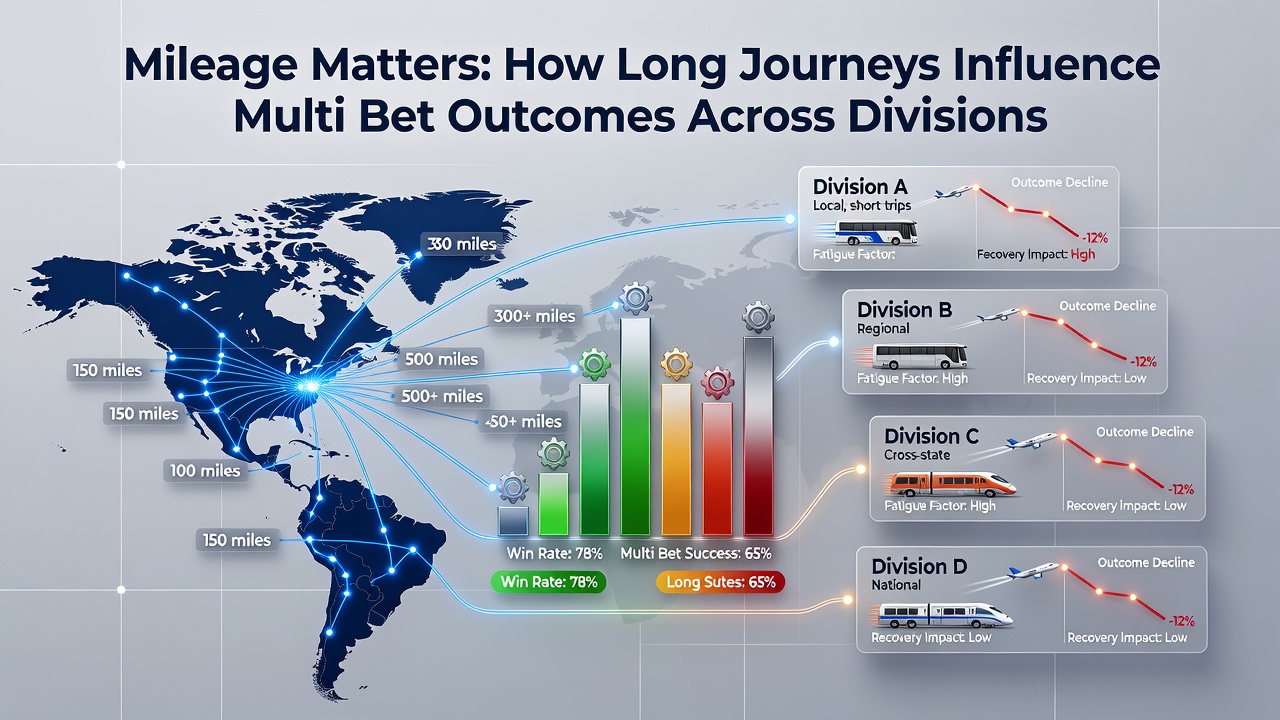
Betting markets that span divisions require separate modeling for each tier because recovery windows differ. A Premier League side returning from a 400-mile round trip typically benefits from better medical and sleep protocols than a League One counterpart covering the same distance. Analysts at academic research centers have quantified these differences, finding that the probability of a clean sheet drops 9 percentage points for lower-division teams after extended travel when the next fixture occurs within 72 hours.
Those constructing accumulators often isolate legs where one team faces significant mileage while the opponent plays locally, and historical results support the approach. Records from the 2024-2025 campaign show that 62 percent of such mismatched fixtures produced under 2.5 goals, a pattern that repeated in early October 2026 rounds. Multi-bet platforms now incorporate travel distance filters that flag these imbalances before odds are finalized.
Division-Specific Patterns and Data Sources
Championship schedules contain more midweek fixtures than the Premier League, and this density amplifies mileage effects when clubs cross the country twice in seven days. Reports issued by sports performance institutes in Canada and Australia document comparable fatigue curves in their domestic leagues, confirming that the relationship between distance and performance holds across geographies. League One and League Two matches display even sharper drops in away performance after journeys exceeding 200 miles, with goal tallies falling by an average of 0.7 per game.
Multi-bet outcomes therefore hinge on accurate mileage calculations rather than form alone. When builders combine selections from several divisions, the cumulative effect of several long journeys can shift expected goal totals enough to move entire accumulator payouts. Data sets released by university sports labs in the United States and the European Union provide granular travel logs that allow precise weighting of each leg in a multi-bet.
Conclusion
Long journeys exert consistent pressure on football results across divisions, and those pressures translate directly into altered probabilities for accumulator markets. Teams facing extended travel post lower points per game, reduced clean-sheet rates, and fewer shots on target, with the impact most pronounced in the Championship, League One, and League Two. Accurate incorporation of mileage data into multi-bet construction refines selection processes and aligns expected outcomes with observed patterns across the 2025-2026 and early 2026-2027 seasons.